


Florida’s Atlantic coast runs from Vero Beach down through Port St. Lucie, Stuart, the Palm Beaches, Fort Lauderdale and Miami, and out to Key West. Seven counties, and more variety than the map suggests. Quiet coastal towns at the north end, some of the country’s most concentrated 55+ development in the middle, and a major international metro at the south.
It’s also the warmest part of the state. Winters here run several degrees milder than the Gulf Coast, which is the whole reason a lot of people choose it.
The honest headline is about money. Four of these seven counties rank in Florida’s top 12 for property tax rates, with St. Lucie the highest in the state. Taxes and insurance combined run from about $11,600 a year in Vero Beach to more than $16,000 in Miami-Dade. The cheapest county here costs more to carry a home in than almost anywhere on the Gulf Coast.
Day-to-day costs, though, are a different story, and they don’t line up the way anyone expects.
The short version
Best for: people who want the warmest winters in the continental U.S., world-class healthcare, real city amenities, and the biggest concentration of 55+ communities in Florida.
Think twice if: your budget is tight. Property taxes and insurance here are the highest of any region I cover.
Counties covered: Indian River, St. Lucie, Martin, Palm Beach, Broward, Miami-Dade, and Monroe (the Keys).
- 55+ communities in this region
- How the seven counties compare
- Cities and towns
- What it costs to live here
- What it costs to carry a home
- Hurricanes, flooding, and insurance
- Weather
- Healthcare
- Is this region right for you?
- How it compares to neighboring regions
- Common questions
Featured Communities in Southeast Florida
Valencia Del Mar – Boynton Beach

Valencia Del Mar takes the renowned Valencia 55+ living to new heights. Located in beautiful Boynton Beach, Florida, this luxurious new community introduces unparalleled sophistication and the best lifestyle living to an already esteemed location. Just minutes from the Atlantic coastline and miles of pristine beaches, with convenient access to major airports, you’ll also be near the vibrant nightlife of Delray Beach along with exceptional dining, shopping, and entertainment. Featuring innovative floorplans, cutting-edge standard features, and exciting new lifestyle options, Valencia Del Mar sets a fresh benchmark for exceptional 55+ living from $1.2M-$2.5M.
Redefining resort-style living, is the expansive clubhouse at the heart of Valencia Del Mar. The 8-acre recreational site features a grand social hall, luxury restaurant with indoor and patio seating, a stylish sports lounge, and world-class spa, complete with steam rooms, saunas, and private treatment suites. Every element of Valencia Del Mar is crafted to deliver an extraordinary living experience for the active adult.
Don’t miss your chance to experience this elevated 55+ lifestyle for yourself. Discover everything Valencia Del Mar has to offer and take the first step toward your dream home today.
Valencia Vista at Riverland – Port St. Lucie
A new chapter of exceptional 55+ living has arrived at Riverland for 55+ in Port St. Lucie, Florida with the grand opening of Valencia Vista! This highly anticipated community introduces an all-new collection of thoughtfully designed homes, including the innovative Club Villas, along with spacious new floorplans featuring open-concept living, flexible spaces, designer kitchens, and enhanced standard features such as upgraded 42″ upper cabinetry, quartz countertops throughout, and expansive kitchen islands that make it easier than ever to create your dream home.
Residents will also enjoy an expanded Social Club with over 54,000 total sq. ft. of resort-style amenities, including a full-service restaurant and bar, resort-style pools, vibrant social spaces, and year-round events curated by a full-time Lifestyle Director. Beyond the clubhouse, Riverland’s extraordinary 4,000-acre master-planned community gives homeowners access from day one to more than 80 outdoor sports courts, a 51,000 sq. ft. Wellness & Fitness Center, a 5-acre Arts & Culture Center, miles of scenic Paseo greenways, parks, and countless opportunities to stay active, social, and inspired every day. Learn more about Valencia Vista at Riverland with homes starting from the mid $300s today and start living the best 55+ Florida lifestyle!
Catalina Palms at Sundance – Port St. Lucie

Catalina Palms at Sundance is Akel Homes’ newest 55+ active adult community in Port St. Lucie, FL, located within the thoughtfully planned 2,500-acre Sundance master-planned community. Designed exclusively for active adults, Catalina Palms offers a vibrant lifestyle experience centered around connection, wellness, and resort-style living.
At the heart of the community is Club Catalina, Port St. Lucie’s largest private community clubhouse, spanning an impressive 56,000 square feet. This resort-style amenity campus features expansive pools with luxurious cabanas, a full-service restaurant with indoor and outdoor dining, a world-class fitness center with cutting-edge equipment, dedicated pickleball and tennis courts, social lounges, art studios, card rooms, a test kitchen, and numerous indoor and outdoor spaces designed for social, recreational, and creative pursuits.
Catalina Palms offers a diverse collection of beautifully designed lifestyle villas and single-story homes ranging from approximately 1,400 to 3,400 square feet under air, with pricing anticipated from the low $300s.
See the full list of 55+ communities in Florida →
How the Seven Counties Compare
| County | Key towns | Couple / month | Property tax* | Insurance** |
|---|---|---|---|---|
| Indian River | Vero Beach, Sebastian | $3,269 | $4,958 | $6,636 |
| St. Lucie | Port St. Lucie, Fort Pierce | $3,014 | $7,545 | $7,693 |
| Martin | Stuart, Palm City, Hobe Sound | $3,191 | $5,621 | $7,741 |
| Palm Beach | West Palm, Boynton, Delray, Boca, Jupiter | $3,281 | $6,122 | $7,918 |
| Broward | Fort Lauderdale, Coral Springs, Weston | $3,062 | $6,952 | $8,025 |
| Miami-Dade | Miami, Aventura, Homestead | $2,951 | $6,471 | $9,774 |
| Monroe | Key West, Marathon, Islamorada | $4,032 | $2,883 | $8,745 |
*Estimated annual property tax on a $400,000 homesteaded home. **Median rate filed with the state for the CHOICES sample home: a masonry home built in 2005 with a $300,000 replacement value, a 2% hurricane deductible, no recent claims, limited wind-mitigation features and no hip roof. Monthly figures are for a retired couple who own their home outright; the Florida average is $3,034 and the U.S. average is $3,244. Sources: Elder Index (Gerontology Institute, UMass Boston), Florida TaxWatch, Florida Office of Insurance Regulation.
Quick orientation
Lowest day-to-day costs: Miami-Dade ($2,951/month), then Port St. Lucie and Broward.
Lowest cost to carry a home: Indian River (~$11,600) and Monroe (~$11,600).
Most expensive to carry: Miami-Dade (~$16,200), St. Lucie (~$15,200), Broward (~$15,000).
Airports: Donald J. Trump International (DJT) formerly known as Palm Beach International Airport (PBI), Fort Lauderdale–Hollywood (FLL), Miami International (MIA), Key West (EYW).
Cities and Towns

The region splits into four distinct areas. Here’s how I’d think about each, with links to everything I’ve written.
The Treasure Coast: quieter and less built-up
Vero Beach down through Stuart. Small-town Atlantic Florida, with the region’s strongest 55+ new-construction pipeline in Port St. Lucie.
Vero Beach and Sebastian (Indian River County)
Genuinely charming, deliberately low-key, and a longtime favorite with retirees who want the Atlantic without the crowds. Indian River has the region’s lowest property tax rate by a wide margin and the lowest insurance rates, which makes it the cheapest county here to own a home in.
Two things to budget for: transportation runs $570 a month for a couple, the highest in the region, because you drive farther for most things. And health care runs $850 a month, also the highest here.
Read more: Vero Beach Retirement Guide
Port St. Lucie and Fort Pierce (St. Lucie County)
One of the fastest-growing 55+ markets in Florida, and the area my readers ask about most on this coast. Port St. Lucie offers newer homes at prices that undercut Palm Beach County substantially, which is the whole appeal.
Be clear-eyed about the tax bill, though. St. Lucie County has the highest average millage rate of all 67 Florida counties — about $7,545 a year on a $400,000 homesteaded home. Day-to-day costs here are below the Florida average, so this is a place that’s cheaper to live in than to be taxed in.
Read more: Port St. Lucie Retirement Guide · Fort Pierce Retirement Guide
Stuart, Palm City, and Hobe Sound (Martin County)
Stuart is one of the prettiest small towns in Florida, with a walkable downtown on the St. Lucie River and a hard-fought tradition of limiting high-rise development. Martin County costs less to carry a home in than Palm Beach and has a much lower tax rate than neighboring St. Lucie (22nd versus 1st), which surprises people who assume the nicer county costs more.
Read more: Stuart Retirement Guide
The Palm Beaches: the heart of 55+ Florida
Nowhere else in the country has this density of active adult communities.
Boynton Beach, Delray Beach, and Boca Raton
This corridor is the epicenter of Florida 55+ living, with dozens of established and new communities within a few miles of each other. Delray’s Atlantic Avenue and Boca’s downtown give you walkable dining and shopping that most 55+ areas can’t match. Palm Beach County has the region’s highest day-to-day costs at $3,281 a month for a couple.
Read more: Palm Beach County 55+ communities · Boynton Beach Retirement Guide · Delray Beach Retirement Guide · Boca Raton Retirement Guide
West Palm Beach, Westlake, and Wellington
West Palm has a real downtown and the region’s most convenient airport. Push inland and you get newer master-planned communities at lower prices. Westlake is the newest of them, while Wellington is horse country, with a very different feel.
Jupiter and Palm Beach Gardens
The north end of the county: beach towns with a lower-key feel than Boca, good golf, and Jupiter Medical Center nearby.
Fort Lauderdale and Miami: the metro
Big-city living, the best healthcare in the state, and the highest carrying costs in Florida.
Fort Lauderdale and Broward County
Beaches, boating, an international airport, and neighborhoods that range from urban high-rise to quiet suburban Weston and Coral Springs. Day-to-day costs are moderate at $3,062 a month. The catch is Broward’s tax rate, fourth-highest in Florida, which pushes annual carrying costs near $15,000.
Read more: 48 Hours in Fort Lauderdale
Miami and Miami-Dade County
Here’s the number that surprised me most in this whole region: Miami-Dade has the lowest day-to-day costs of any county on this coast, at $2,951 a month for a couple — below the Florida average. The driver is health care, at $672 a month, the lowest here and well under Vero Beach’s $850. An enormous hospital market with heavy competition does that.
The reversal comes at the closing table. Miami-Dade’s insurance is the most expensive in the region, and combined with its tax rate, it’s the costliest county in Florida to carry a home in, at roughly $16,245 a year. Great if you already own. Expensive if you’re buying.
The Florida Keys
A category of its own, in every sense.
Key West, Marathon, and Islamorada (Monroe County)
The Keys have the lowest property tax rate in Florida (67th of 67) and the highest cost of living of anywhere I track, at $4,032 a month for a couple, 24% above the national average. Health care is the biggest driver, running close to double what it costs in most of the state.
Insurance here is its own universe. Filed rates for the sample home range from $2,860 to $37,947, a thirteen-fold spread and by far the widest in Florida. There’s very little 55+ community inventory, so you’re buying an existing home. People who love the Keys love them completely; just go in knowing the numbers.
Read more: Retirement living in the Florida Keys
What It Costs to Live Here
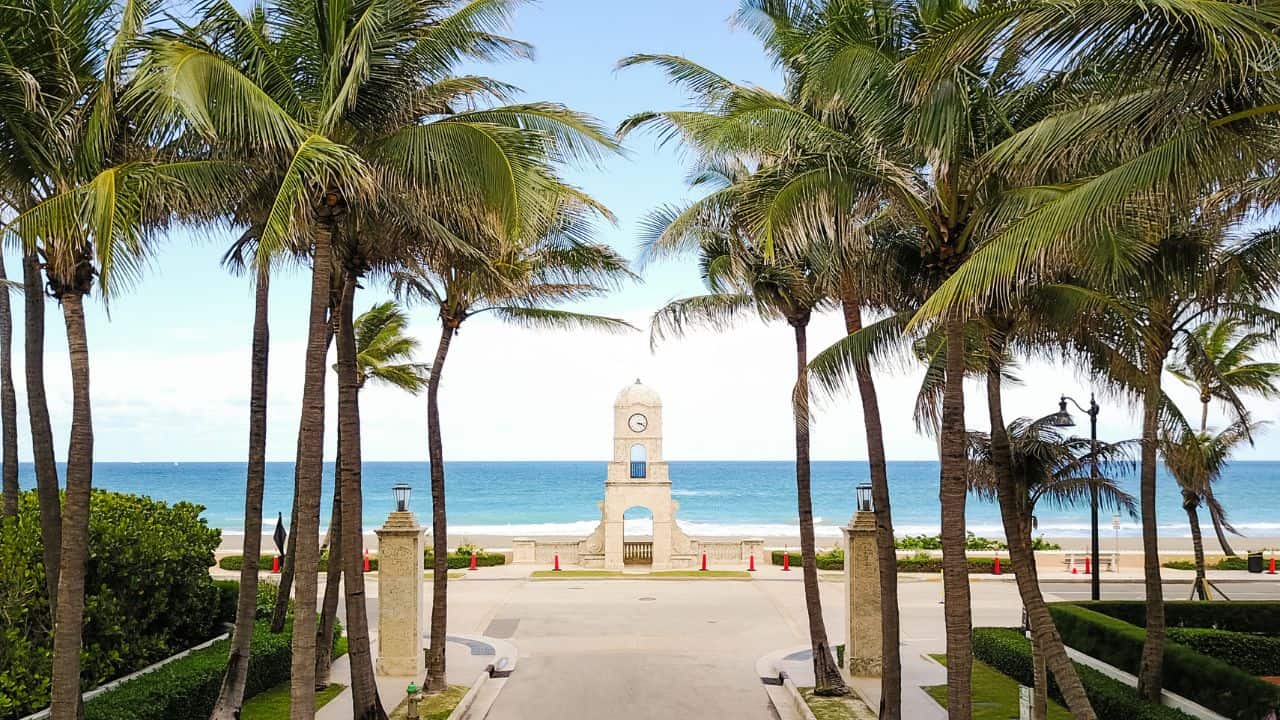
For a retired couple who owns their home outright, covering the basics ranges from $2,951 a month in Miami-Dade to $4,032 in the Keys. The Florida average is $3,034 and the national average is $3,244.
Only two counties here beat the Florida average, and three land above the national one. Compare that to the Gulf Coast between Sarasota and Cedar Key, where every single county comes in under the Florida average, and you have the clearest difference between Florida’s two coasts.
The Treasure Coast isn’t the bargain people assume
Martin County at $3,191 and Indian River at $3,269 both cost more day to day than Broward at $3,062. Stuart and Vero are quieter than Fort Lauderdale, not cheaper. Two reasons: you drive farther for everything, and health care costs more where there’s less competition among providers. Port St. Lucie at $3,014 is the exception, and the reason it draws the crowds it does.
See my full cost of living in Florida breakdown for how these figures are calculated.
What It Costs to Carry a Home
Monthly living costs are only half the picture. The other half is what the county charges you in property tax and what an insurer charges to cover the house. On this coast, that second half is where the money goes.
| County | Property tax | Insurance (median) | Combined |
|---|---|---|---|
| Indian River | $4,958 | $6,636 | ~$11,594 |
| Monroe | $2,883 | $8,745 | ~$11,628 |
| Martin | $5,621 | $7,741 | ~$13,362 |
| Palm Beach | $6,122 | $7,918 | ~$14,040 |
| Broward | $6,952 | $8,025 | ~$14,977 |
| St. Lucie | $7,545 | $7,693 | ~$15,238 |
| Miami-Dade | $6,471 | $9,774 | ~$16,245 |
Property tax is the estimated annual bill on a $400,000 homesteaded home. Insurance is the median rate filed with the state for the CHOICES sample home described above. These are two different example homes, so use the combined figure to compare counties rather than as a quote for a specific house. CDD assessments, where they apply, are on top of both.
The cheapest county here would be near the top on the Gulf Coast. Indian River at about $11,594 costs more than every county between Sarasota and Cedar Key except Pasco. Palm Beach costs roughly $5,100 a year more than Sarasota. If carrying cost is what drives your decision, the Atlantic side starts at a disadvantage.
A crucial caveat on the insurance figures, especially for new construction. The state’s sample home is a masonry house built in 2005 with limited wind-mitigation features and no hip roof. That’s not what most of my readers are buying. A new home built to today’s code, with impact glass, a hip roof and full mitigation credits, earns discounts the sample home doesn’t. This matters a lot in places like Port St. Lucie and Westlake, where nearly all the 55+ inventory is new. Use these numbers to compare counties, then get real quotes on the specific address.
For the full statewide rankings, see Florida property tax rates by county, and don’t overlook the homestead exemption if this will be your primary residence.
Hurricanes, Flooding, and Insurance
The Atlantic coast has its own storm history. Frances and Jeanne both came ashore near Stuart in 2004, three weeks apart. Wilma crossed South Florida in 2005. Irma tore through the Middle Keys in 2017. And Andrew flattened south Miami-Dade in 1992, which led Florida to rewrite its building code.
That last one has an upside worth knowing about. Miami-Dade and Broward sit in the High-Velocity Hurricane Zone, the strictest building standard in the country. A newer home built to that standard is about as storm-resistant as residential construction gets in the United States.
Three things determine your actual exposure:
Flood zone and elevation. Surge and flooding do most of the damage, and both are extremely local. Pull the FEMA flood map for any specific address before you get attached to it. My guide to Florida flood zones explains how to read them. Worth adding: in low-lying parts of Miami-Dade and Broward, king tides now cause street flooding on clear days, independent of any storm. Ask locally about the specific street.
How the home was built, and when. Post-2002 construction with impact windows and a newer roof performs very differently from older housing stock, and insurers price it accordingly.
Which carrier you use. Filed rates for the same sample home range from $3,228 to $16,645 in Broward, $3,737 to $20,327 in Palm Beach, and $2,860 to $37,947 in Monroe. Get quotes from several companies. On this coast, the difference between carriers can exceed your entire property tax bill.
For the statewide view, see where to live in Florida to avoid hurricanes.
Weather
This is the warmest stretch of the continental United States, and the further south you go, the more that shows up at night.
| Fort Pierce | West Palm Beach | Fort Lauderdale | Key West | |
|---|---|---|---|---|
| January high / low | 72° / 53° | 75° / 58° | 76° / 58° | 76° / 66° |
| August high / low | 89° / 75° | 90° / 77° | 91° / 76° | 91° / 81° |
| Annual rainfall | 55.9 in. | 61.8 in. | 68.8 in. | 40.4 in. |
Source: 1991–2020 normals from the Florida Climate Center, Office of the State Climatologist. Fort Pierce, West Palm Beach International, Fort Lauderdale and Key West International stations.
The winter gradient is the real story. January lows run 53°F at Fort Pierce, 58°F in West Palm and Fort Lauderdale, and 66°F in Key West. That 13-degree spread over 250 miles is why some snowbirds keep driving south past perfectly nice places. For comparison, Tampa’s January low is 53°F and Fort Myers is 54°F — so West Palm and Fort Lauderdale evenings run about five degrees warmer than anywhere on the Gulf Coast.
Fort Lauderdale is wet. At 68.8 inches a year it gets nearly 20 more inches than Tampa and 11 more than Fort Myers. Key West, oddly, is the driest place in this entire guide at 40.4 inches, because the islands are too narrow to generate the afternoon thunderstorms the mainland gets.
Summers are hot everywhere here, and Key West barely cools off at all. An August low of 81°F is a different experience from an August low of 75°F.
My advice: visit twice. Once in January, when this coast is at its best, and once in August, which is what living here year-round actually feels like.
Healthcare
This is the region’s strongest card, and for many readers it’s the deciding one.
Miami-Dade and Broward have the deepest medical resources in Florida: Jackson Health System, Baptist Health South Florida, Memorial Healthcare, the University of Miami’s Sylvester Comprehensive Cancer Center, and Cleveland Clinic Florida in Weston. Palm Beach County has Baptist Health Boca Raton Regional and Jupiter Medical Center. On the Treasure Coast, Cleveland Clinic operates Martin Health in Stuart and Indian River Hospital in Vero Beach, which is a notable amount of horsepower for towns that size. Fort Pierce has HCA Florida Lawnwood.
The Keys are the exception. Serious or specialized care generally means a trip to Miami, which is part of why health care costs there run close to double the state norm.
Is This Region Right for You?
Reasons people love it
- The warmest winters in the continental U.S.
- The deepest concentration of 55+ communities anywhere
- World-class hospitals and specialists
- Major airports at West Palm Beach, Fort Lauderdale, and Miami
- Walkable downtowns in Delray, Stuart, and West Palm
- Culture, dining, and sports you won’t find in quieter regions
Reasons people hesitate
- The highest carrying costs of any Florida region
- St. Lucie’s tax rate, the highest in the state
- Insurance quotes that vary five-fold within one county
- Traffic on I-95 and the Turnpike
- King-tide flooding in low-lying coastal areas
How This Region Compares to Its Neighbors
Southwest Florida including Naples, Fort Myers, and Punta Gorda, is the Gulf-side equivalent, with similar winters, comparable upscale communities, and noticeably lower property taxes.
Tampa Bay and the Nature Coast is the value alternative. Every county there costs less than the Florida average to live in, and carrying costs run thousands less per year. You do trade a few degrees of winter warmth for it.
Central Florida trades the coast entirely for lower costs and much less storm exposure.
Common Questions
Is Southeast Florida a good place to retire?
It is if warmth, healthcare, and community selection matter more to you than cost. This coast has the mildest winters in the continental U.S., the best hospitals in Florida, and the deepest concentration of 55+ communities anywhere in the country. It’s also the most expensive region in the state to own a home in, mainly because of property taxes and insurance.
What’s the most affordable place to retire in Southeast Florida?
It depends on which cost you mean. For day-to-day living, Miami-Dade is the cheapest at $2,951 a month for a couple, followed by Port St. Lucie at $3,014. For the cost of owning a home, Indian River County (Vero Beach) is the lowest at roughly $11,600 a year in property tax and insurance combined.
Why are property taxes so high in Port St. Lucie?
St. Lucie County has the highest average millage rate of all 67 Florida counties, at about $7,545 a year on a $400,000 homesteaded home. That’s the trade-off for home prices that run well below Palm Beach County. Day-to-day living costs there are actually below the Florida average, so it’s cheaper to live in than to be taxed in.
Is Miami expensive for retirees?
Less than you’d think to live in, more than you’d think to own in. Miami-Dade has the lowest day-to-day costs of any county on this coast at $2,951 a month for a couple, helped by the lowest health care costs in the region. But its combined property tax and insurance bill is the highest in Florida, at roughly $16,245 a year.
How much warmer is Southeast Florida than the Gulf Coast in winter?
About five degrees at night, which is more noticeable than it sounds. January lows average 58°F in West Palm Beach and Fort Lauderdale versus 53°F in Tampa and 54°F in Fort Myers. Key West is warmer still, at 66°F.
Why do insurance quotes vary so much here?
Carriers price coastal risk very differently. For the same sample home, filed rates range from $3,228 to $16,645 in Broward County and from $2,860 to $37,947 in the Keys. Always get quotes from several companies, and remember that a newer home with impact windows and full wind-mitigation credits will price well below the state’s sample home, which is a 2005 build with limited mitigation.
Where are the 55+ communities in Southeast Florida?
The heaviest concentration by far is in Palm Beach County, along the Boynton Beach–Delray Beach–Boca Raton corridor and inland around Westlake. Port St. Lucie is the fastest-growing market on the Treasure Coast.
Updated: September 2026