


Northeast Florida runs from the Georgia line down to Palm Coast: Amelia Island, Jacksonville and its beaches, Ponte Vedra, St. Augustine, and the St. Johns River country inland. Spanish moss, marshland, a 450-year-old downtown, and some of the least crowded beaches in the state.
Here’s what the numbers say, and it’s the best-kept secret in Florida retirement. This is the cheapest coastal region in the state to own a home in. Property taxes and insurance combined run from about $7,800 a year in Clay County to $9,600 in Flagler. St. Augustine costs roughly $5,800 a year less to carry than Miami-Dade — on the same ocean.
The reason is insurance. Filed rates up here are the lowest in Florida, because hurricane exposure drops off sharply this far north. Amelia Island is oceanfront and still insures for less than most of inland Central Florida.
The trade-off is winter. It’s real, and I’d rather you hear it now.
The short version
Best for: buyers who want the coast without coastal costs, anyone who likes four actual seasons, military retirees, and people who value history and character over resort amenities.
Think twice if: you’re moving south to escape cold weather entirely. January mornings here can start below freezing.
Counties covered: Duval, St. Johns, Clay, Nassau, Flagler, and Putnam.
- 55+ communities in Northeast Florida
- How the six counties compare
- Cities and towns
- What it costs to live here
- What it costs to carry a home
- Storms, flooding, and insurance
- Weather
- Healthcare
- Is this region right for you?
- How it compares to neighboring regions
- Common questions
Featured Communities

Del Webb Saint Johns brings the proven Del Webb 55+ formula to Northeast Florida, offering active adults a premium community just outside historic St. Augustine.
What sets this community apart is its strategic location — you get all the amenities Del Webb is known for while being close to both Atlantic beaches and one of America’s oldest cities.
Prices start in the mid $400k’s.

Reverie at Trailmark is a 55+ community in St. Augustine. The Lodge is a 4,600 sq. ft. Lakeside Clubhouse that features indoor and outdoor social spaces, six pickleball courts, a resort-style pool and spa, a catering kitchen, and what sounds to me like one of the coolest amenities…an open-air Bier Garten.
There are 11 new single-family home designs, ranging from 1,500 to 3,000 sq. ft. The community features lakeside and preserve homesites. Prices start in the $300k’s.
WaterSong at RiverTown is a 55+ community in Northeast Florida.
Situated almost equidistant between Jacksonville and St. Augustine, the RiverTown master-planned community is located along the banks of the St. John’s River.
Like most master-planned communities, there are multiple neighborhoods within RiverTown, and WaterSong is the only one right now that is designated 55+. Prices start in the low $400k’s.

With Reverie at Silverleaf, Dream Finders Homes is bringing their expertise to St. Augustine’s 55+ market, positioning this gated community within the larger Silverleaf master-planned development.
The amenities focus heavily on active lifestyle elements like pickleball, but the real appeal here is the combination of St. Augustine’s coastal proximity with access to both the historic downtown and modern conveniences, all without CDD fees. Prices start in the mid-$300k’s.

Sweetwater by Del Webb brought the trusted Del Webb 55+ lifestyle to the Jacksonville area, making it North Florida’s first Del Webb community.
With world-class amenities, easy access to beaches and urban conveniences, and a fully built-out community offering resale opportunities, Sweetwater delivers proven active adult living in one of Florida’s most livable cities. Prices start in the mid $300k’s.

Reverie at Palm Coast is a brand new 55+ community located in a naturally beautiful setting at the heart of the abundant activities, great golf and sparkling ocean waters that rank this area as one of the top beach towns in the country.
Reverie will include a staffed amenities center with an outdoor zero-entry swimming pool, separate spa, fitness center with fitness on-demand video system, 6 tournament-style pickleball courts, grand event lawn, multiple gathering areas, party bar, social clubs, separate aerobics area, golf simulator, putting green and much more.
Reverie will feature 15 different home designs in 3 home collections that range from 1,693 sq. ft to over 3,700 sq. ft in living area with 2 and 3-car garages. Pre-construction prices start from the mid $300,000 to mid $500,000 range with many homesite views, design elements and options to choose from.
See the full list of 55+ communities in Florida →
How the Six Counties Compare
| County | Key towns | Couple / month | Property tax* | Insurance** |
|---|---|---|---|---|
| Duval | Jacksonville, Jacksonville Beach | $2,933 | $6,262 | $3,120 |
| St. Johns | St. Augustine, Ponte Vedra, Nocatee | $3,036 | $4,891 | $3,312 |
| Clay | Orange Park, Fleming Island, Middleburg | $2,869 | $5,371 | $2,404 |
| Nassau | Fernandina Beach, Amelia Island, Yulee | $2,983 | $5,620 | $2,758 |
| Flagler | Palm Coast, Flagler Beach | $3,017 | $6,004 | $3,565 |
| Putnam | Palatka, Crescent City | $2,844 | $6,200 | $2,556 |
*Estimated annual property tax on a $400,000 homesteaded home. **Median rate filed with the state for the CHOICES sample home: a masonry home built in 2005 with a $300,000 replacement value, a 2% hurricane deductible, no recent claims, limited wind-mitigation features and no hip roof. Monthly figures are for a retired couple who own their home outright; the Florida average is $3,034 and the U.S. average is $3,244. Sources: Elder Index (Gerontology Institute, UMass Boston), Florida TaxWatch, Florida Office of Insurance Regulation.
Quick orientation
Lowest day-to-day costs: Putnam ($2,844/month), then Clay and Duval.
Lowest cost to carry a home: Clay, at roughly $7,775 a year — second-lowest of any county in Florida.
Cheapest insurance in the state: Clay at a $2,404 median, with Putnam and Nassau close behind.
Airport: Jacksonville International (JAX).
Cities and Towns

Two clusters here, plus one inland outlier. Links to everything I’ve written are under each town.
Jacksonville and the north end
A big city that doesn’t feel like one, its beach towns, and Amelia Island up against the Georgia line.
Jacksonville and the Beaches (Duval County)
Jacksonville is the largest city by land area in the lower 48, which means it’s really a collection of neighborhoods — riverfront districts downtown, the low-key beach towns of Jacksonville Beach, Neptune Beach and Atlantic Beach, and newer master-planned development on the south side. It has the region’s lowest day-to-day costs at $2,933 a month for a couple.
The catch is the tax rate. Duval ranks 9th of Florida’s 67 counties, the highest in this region, so the carrying cost lands above its neighbors. Jacksonville is cheaper to live in than to buy into — the same pattern you see in Tampa.
Read more: Jacksonville Retirement Guide
Orange Park, Fleming Island, and Middleburg (Clay County)
Clay is the value play, and it’s underrated. It has the cheapest homeowners insurance in Florida at a $2,404 median, a moderate tax rate, and low living costs. Add it up and Clay is the second-cheapest county in the entire state to carry a home in, behind only Sumter.
You’re 20 to 30 minutes from downtown Jacksonville, so you get the metro’s hospitals and airport for roughly $1,600 a year less than living in Duval. It’s also long been popular with military retirees, given NAS Jacksonville just up the road.
Fernandina Beach and Amelia Island (Nassau County)
Thirteen miles of beach, a Victorian downtown, and the shrimping history to go with it. Amelia Island is one of the most appealing small places in Florida, and here’s the part that surprises people: it’s oceanfront and insures for a $2,758 median — less than Marion County, less than Orlando, less than anywhere on the Gulf Coast. Hurricane exposure drops off sharply this far north, and the filings reflect it.
Housing costs are the highest of the six at $618 a month, so the island premium is real. It’s just much smaller than the equivalent premium down south.
Read more: Amelia Island Retirement Guide · 48 Hours in Amelia Island
St. Augustine to Palm Coast
The historic coast, and the region’s strongest 55+ market.
St. Augustine, Ponte Vedra, and Nocatee (St. Johns County)
St. Augustine is the oldest continuously occupied European settlement in the country, and it’s genuinely lovely — coquina fort, narrow streets, quiet beaches just over the bridge. Ponte Vedra is the upscale golf address, and Nocatee has become one of the best-selling master-planned communities in America.
Here’s the surprise: this is the most desirable county in the region and it has the lowest property tax rate of the six, 54th of 67 statewide. All in, St. Johns is the second-cheapest county here to carry a home in. If you assumed St. Augustine was out of reach, look again.
Read more: St. Augustine Retirement Guide · 48 Hours in St. Augustine
Palm Coast and Flagler Beach (Flagler County)
Palm Coast is a planned community that grew into a city, with an enormous grid of canals and quiet residential streets, plus miles of undeveloped shoreline at Flagler Beach. Popular with Northeast transplants and a common stop for people who found Daytona too busy and St. Augustine too pricey.
Flagler carries the region’s highest insurance median at $3,565 and a mid-range tax rate, which makes it the most expensive of the six to carry, though still cheaper than almost anywhere on the Gulf or Atlantic coasts. Beach erosion along A1A is a live local issue worth asking about if you’re shopping oceanfront.
Read more: Palm Coast Retirement Guide
Palatka and Putnam County
Inland on the St. Johns River, and the cheapest day-to-day living in the region at $2,844 a month. There’s very little 55+ community inventory here, so you’re generally buying an existing home. Two caveats that follow rural Florida everywhere: transportation runs $509 a month, the highest of the six, and health care $814, so the savings on housing get partly spent on driving and doctors. The tax rate is also surprisingly high at 11th in the state.
What It Costs to Live Here
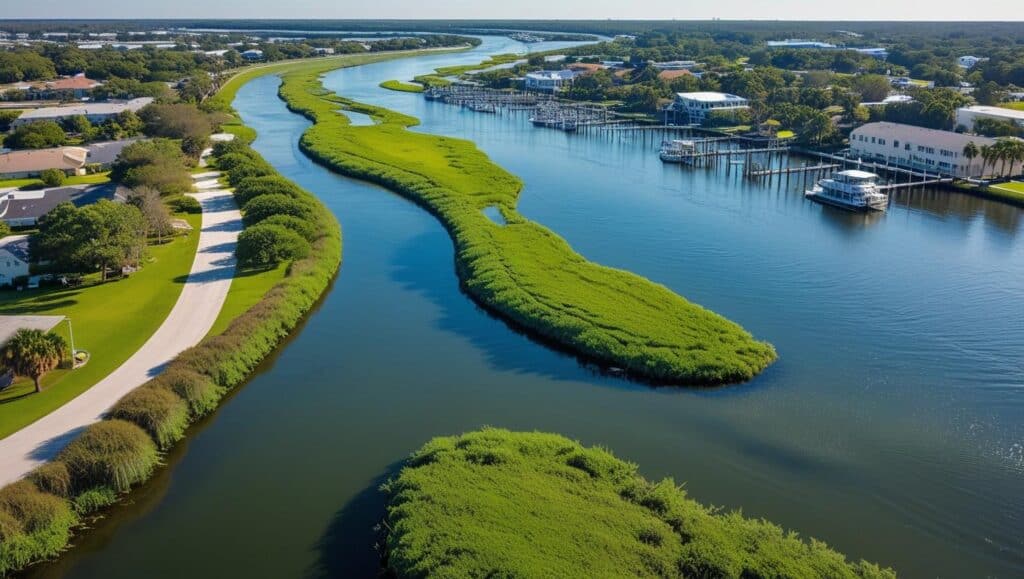
For a retired couple who owns their home outright, covering the basics ranges from $2,844 a month in Putnam County to $3,036 in St. Johns. The Florida average is $3,034 and the national average is $3,244.
Every county here beats the national average, and five of six beat the Florida average. What’s unusual is how little variation there is: just $192 a month separates the cheapest county from the priciest. On the Atlantic coast that gap is more than $1,000.
St. Augustine costs almost the same as Palatka
The most sought-after address in the region runs $3,036 a month for a couple. Rural Putnam County runs $2,844. That’s a $192 difference for a completely different life. Housing is where the gap shows up, and even there it’s modest. In this region, what you pay for is less about the county and more about the specific house.
See my full cost of living in Florida breakdown for how these figures are calculated.
What It Costs to Carry a Home
This is the region’s real advantage, and almost nobody talks about it.
| County | Property tax | Insurance (median) | Combined |
|---|---|---|---|
| Clay | $5,371 | $2,404 | ~$7,775 |
| St. Johns | $4,891 | $3,312 | ~$8,203 |
| Nassau | $5,620 | $2,758 | ~$8,378 |
| Putnam | $6,200 | $2,556 | ~$8,756 |
| Duval | $6,262 | $3,120 | ~$9,382 |
| Flagler | $6,004 | $3,565 | ~$9,569 |
Property tax is the estimated annual bill on a $400,000 homesteaded home. Insurance is the median rate filed with the state for the CHOICES sample home described above. These are two different example homes, so use the combined figure to compare counties rather than as a quote for a specific house. CDD assessments, where they apply, are on top of both.
Northeast Florida is the cheapest coastal region in the state. Every county here beats every county on the Atlantic coast to the south, and all but two on the Gulf. St. Augustine runs about $5,800 a year less than Miami-Dade and roughly $3,900 less than Palm Beach County, with an ocean either way.
Clay County is second only to Sumter statewide, at about $7,775 a year. Its $2,404 insurance median is the lowest filed rate anywhere in Florida.
Clay versus Duval is worth about $1,600 a year. Same hospitals, same airport, 20 to 30 minutes apart. If Jacksonville access is the goal, the county line matters.
One caveat on the insurance figures. The state’s sample home is a masonry house built in 2005 with limited wind-mitigation features. A newer home built to current code, with impact glass and a hip roof, earns discounts the sample doesn’t. Use these to compare counties, then get real quotes on a specific address.
For the full statewide rankings, see Florida property tax rates by county, and don’t overlook the homestead exemption if this will be your primary residence.
Storms, Flooding, and Insurance
Northeast Florida gets hit less often than the peninsula south of it, and insurers price that in. Less often is not never.
Matthew brushed the coast in 2016 and did serious damage along A1A in St. Augustine and Flagler Beach. Irma in 2017 pushed record flooding into downtown Jacksonville and the St. Augustine historic district, driven up the St. Johns River rather than straight off the ocean. And Nicole in 2022 caused severe beach erosion along this stretch, undermining oceanfront structures.
So the risks here have their own shape:
- River and creek flooding. The St. Johns River runs right through the region and floods from the wrong combination of surge, rain and tide. A home can be miles from the ocean and still be in a flood zone. Check the FEMA map for the specific address — my guide to Florida flood zones explains how to read it.
- Beach erosion. A live issue in Flagler and parts of St. Johns. If you’re shopping oceanfront, ask about the dune line, recent renourishment projects, and what the county has planned.
- Nor’easters, not just hurricanes. This far north you also get winter coastal storms, which don’t make national news but do push water around.
Shop your insurance regardless. Even with the lowest medians in Florida, the spreads are wide: Clay’s filed rates run from $1,801 to $8,003 for the same house, and St. Johns from $1,811 to $8,124.
For the statewide view, see where to live in Florida to avoid hurricanes.
Weather
This is the part to be straight about. Northeast Florida has the coldest winters in the state, and it isn’t close.
| Jacksonville | Orlando | Fort Myers | Fort Lauderdale | |
|---|---|---|---|---|
| January high | 66°F | 72°F | 75°F | 76°F |
| January low | 43°F | 50°F | 54°F | 58°F |
| August high / low | 91° / 73° | 92° / 74° | 92° / 75° | 91° / 76° |
| Annual rainfall | 53.4 in. | 51.5 in. | 57.4 in. | 68.8 in. |
1991–2020 normals from the Florida Climate Center, Office of the State Climatologist. Jacksonville International Airport station, plus the comparison stations noted.
Summers are the same everywhere in Florida. Winters are not. August in Jacksonville is within a degree of Fort Lauderdale. January runs 10 degrees cooler by day and 15 cooler at night. Freezing mornings are a normal part of winter here, not an event, and Jacksonville is the one part of Florida where you’ll genuinely use the heat — it logs roughly five times the heating demand of Fort Myers.
Whether that’s a drawback depends entirely on you. A lot of people up here chose it on purpose: you get four distinct seasons, fall actually feels like fall, and you can be outside in July mornings and January afternoons alike. If you’re moving south specifically to never be cold again, this isn’t your region. If you wanted mild rather than tropical, it might be exactly right.
My advice: visit in January as well as August. Most people only test the summer.
Healthcare
Strong, and anchored by a genuine destination. Mayo Clinic’s Florida campus is in Jacksonville, one of only three Mayo campuses in the country, and by itself a reason some people choose this region. Alongside it are Baptist Health, UF Health Jacksonville, and Ascension St. Vincent’s, which together give the metro real depth.
Outside Duval, St. Augustine has its own hospital, Palm Coast has AdventHealth Palm Coast, and Nassau County is served from Fernandina Beach with Jacksonville 30 minutes away. Palatka is the thinnest coverage, and Putnam’s health care costs reflect it at $814 a month for a couple.
Worth noting for veterans: with NAS Jacksonville, Naval Station Mayport and Kings Bay just over the Georgia line, this region has a large military-retiree population and the services that come with it. It’s a big part of why Clay County draws the crowd it does.
Is This Region Right for You?
Reasons people love it
- The cheapest coastal living in Florida
- The lowest insurance rates in the state
- Mayo Clinic, plus three more hospital systems
- St. Augustine, Amelia Island, and real history
- Uncrowded beaches, even in season
- Four actual seasons, if that’s what you want
Reasons people hesitate
- The coldest winters in Florida, with freezes
- Duval’s tax rate, 9th-highest in the state
- River flooding well inland of the ocean
- Beach erosion along parts of the coast
- Fewer large 55+ communities than Central or South Florida
- One airport, with fewer direct flights than Orlando or Tampa
How Northeast Florida Compares to Its Neighbors
Central Florida is the only region cheaper to own in, and it’s about 90 minutes south. You trade the ocean for slightly warmer winter nights and the lowest carrying costs in the state.
Southeast Florida is the same Atlantic coast, 15 degrees warmer at night in January, and roughly $4,000 to $8,000 a year more expensive to carry a home in.
Heading south along the coast, Daytona Beach and New Smyrna are the next step down, with a slightly milder winter and a busier beach scene.
Common Questions
Is Northeast Florida a good place to retire?
It’s the best value on the Florida coast. Every county beats the national average on day-to-day costs, and it has the lowest homeowners insurance rates in the state, so it’s the cheapest coastal region to own a home in. You also get Mayo Clinic, St. Augustine and Amelia Island. The trade-off is the coldest winters in Florida, with freezing mornings most years.
What’s the cheapest place to retire in Northeast Florida?
For day-to-day costs, Putnam County (Palatka) at $2,844 a month for a couple. For the cost of owning a home, Clay County — Orange Park and Fleming Island — at roughly $7,775 a year in property tax and insurance combined, second-lowest of any county in Florida.
Why is homeowners insurance so cheap in Northeast Florida?
Hurricane exposure drops off sharply this far north, and carriers price accordingly. Clay County’s median filed rate is $2,404 and Amelia Island’s Nassau County is $2,758 — oceanfront, and still cheaper than most of inland Central Florida. For comparison, Miami-Dade’s median is $9,774 for the same house.
Is St. Augustine expensive to retire in?
Less than you’d expect. St. Johns County has the lowest property tax rate of the six counties here, 54th of Florida’s 67, and its combined tax and insurance bill is the second-lowest in the region at about $8,203 a year. Day-to-day costs run $3,036 a month for a couple, barely above the Florida average.
How cold does it get in Jacksonville?
January averages a high of 66°F and a low of 43°F, with freezing mornings a normal part of most winters. That’s 10 to 15 degrees cooler than South Florida. Summers are essentially identical to the rest of the state, with August highs near 91°F.
Orange Park or Jacksonville?
Clay County costs about $1,600 a year less to carry a home in than Duval, thanks to the lowest insurance rates in Florida and a lower tax rate, and you’re still 20 to 30 minutes from downtown Jacksonville, its hospitals and the airport. If metro access is what you want, Clay is the cheaper side of the line.
Where are the 55+ communities in Northeast Florida?
They’re concentrated in St. Johns County around St. Augustine and Nocatee, on Jacksonville’s south side in Duval, and in Clay County around Orange Park and Fleming Island. Nassau County has a growing pipeline around Yulee.
Updated: September 2026