


Central Florida is the part of the state that isn’t about the beach. It runs from Ocala down through The Villages and the Lake County towns, across Greater Orlando, and south into Polk County. Rolling horse country, spring-fed lakes, the largest 55+ community in America, and a metro with an international airport and some of the best hospitals in Florida.
Here’s the number that matters. This is the cheapest part of Florida to own a home in, and it isn’t close. Property taxes and insurance combined run from about $7,100 a year in Sumter County to $10,500 in Orange. Every county here is cheaper to carry than almost anything on either coast, and Miami-Dade costs more than twice what Sumter does.
The reason is simple: no storm surge. Insurers price coastal risk heavily, and you’re 60 to 90 minutes from either coast here. You give up the beach; you keep the money.
The short version
Best for: value-focused buyers, anyone who wants amenities over oceanfront, and people who want to be within driving distance of both coasts without paying coastal costs.
Think twice if: living near the water is non-negotiable, or you want the warmest possible winters — inland nights run noticeably cooler than the coasts.
Counties covered: Marion, Sumter, Lake, Orange, Seminole, Osceola, and Polk.
- 55+ communities in Central Florida
- How the seven counties compare
- Cities and towns
- What it costs to live here
- What it costs to carry a home
- Storms, flooding, and insurance
- Weather
- Healthcare
- Is this region right for you?
- How it compares to neighboring regions
- Common questions
55+ Communities in Central Florida

At On Top of the World Communities, active adults will find all they dream about and so much more. Located in beautiful Ocala Florida, On Top of the World residents can enjoy any schedule that suits their tastes – from activity-packed to unhurried.
Amenities include 54 holes of golf on three courses, indoor and outdoor swimming pools, tennis courts, a 14-acre R/C flying field, bocce, racquetball and basketball courts, fitness center, health club and spa, restaurants, cultural venues, and much more. Residents can also participate in over 175 clubs, leagues, hobbies, and lifelong learning opportunities.
There are around 20 different floor plans available with prices ranging to suit every budget starting in the $200k’s.

Del Webb Stone Creek is a gated, 55+ active adult community located in the horse capital of the world, Ocala, FL. The community has an 18-hole championship golf course, restaurant, resort-style pools, fitness center, spa, multiple game courts, a full-time lifestyle director and more. Home prices start in the $200k’s.

Del Webb Sunbridge is a new 55+ gated community in St. Cloud, just minutes from Lake Nona and Orlando.
The 27,000 sf. Hammock Club features luxurious indoor and outdoor amenities like a zero-entry pool, resistance pool, pickleball and tennis courts, a fitness center, a movement studio, and more. Attached villas here start in the $300k’s and single-family homes are also available.
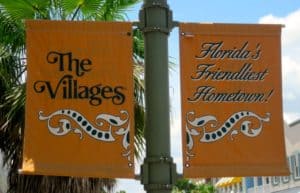
Located about an hour north of Orlando, The Villages is the most popular retirement community in the country, regularly selling more than 3,000 new homes per year.
Now home to more than 150,000 residents, people are attracted to The Villages because of its many golf courses, activities, amenities, and the convenience of having almost everything be golf cart accessible.
Home prices start in the $200k’s.
See the full list of 55+ communities in Florida →
How the Seven Counties Compare
| County | Key towns | Couple / month | Property tax* | Insurance** |
|---|---|---|---|---|
| Marion | Ocala, Dunnellon | $2,744 | $5,559 | $3,147 |
| Sumter | The Villages, Wildwood, Bushnell | $3,148 | $3,922 | $3,214 |
| Lake | Clermont, Leesburg, Mount Dora, Groveland | $2,971 | $5,471 | $3,685 |
| Orange | Orlando, Winter Garden, Lake Nona | $3,010 | $6,094 | $4,369 |
| Seminole | Lake Mary, Sanford, Oviedo | $3,017 | $5,372 | $3,544 |
| Osceola | Kissimmee, St. Cloud, Harmony | $2,861 | $5,241 | $4,490 |
| Polk | Lakeland, Winter Haven, Poinciana | $2,850 | $5,403 | $4,221 |
*Estimated annual property tax on a $400,000 homesteaded home. **Median rate filed with the state for the CHOICES sample home: a masonry home built in 2005 with a $300,000 replacement value, a 2% hurricane deductible, no recent claims, limited wind-mitigation features and no hip roof. Monthly figures are for a retired couple who own their home outright; the Florida average is $3,034 and the U.S. average is $3,244. Sources: Elder Index (Gerontology Institute, UMass Boston), Florida TaxWatch, Florida Office of Insurance Regulation.
Quick orientation
Lowest day-to-day costs: Marion ($2,744/month), then Polk and Osceola.
Lowest cost to carry a home: Sumter, at roughly $7,136 a year — the lowest of any county in Florida.
Most expensive to carry: Orange (~$10,463), which is still cheaper than most coastal counties.
Airports: Orlando International (MCO) and Orlando Sanford (SFB).
Distance to a beach: roughly an hour to 90 minutes, either coast.
Cities and Towns

Three distinct areas here. Links to everything I’ve written are under each town.
The Villages, Ocala, and the Lake County towns
The heart of 55+ Florida, plus horse country and a string of lakeside towns.
The Villages
The largest 55+ community in the country, spread across Sumter, Lake and Marion counties, with golf courses, town squares and nightly entertainment on a scale nothing else matches. Sumter County has the third-lowest property tax rate in Florida, which is a big part of the appeal.
Two things the county numbers don’t capture: the monthly amenity fee and CDD bond assessments, neither of which appears in the millage rate. Sumter also has the highest day-to-day living costs of any county in this region, at $3,148 a month for a couple. I’ve broken the full picture down separately.
Read more: The Villages guide · What it costs to live in The Villages · Alternatives to The Villages
Ocala and Marion County
Horse country, with rolling pastures that don’t look like anyone’s mental image of Florida. Marion has the lowest day-to-day costs in the region at $2,744 a month for a couple — the cheapest place on my entire cost of living list — and the lowest insurance rates here. It’s home to On Top of the World, one of Florida’s largest and longest-running 55+ communities.
Read more: Ocala Retirement Guide · On Top of the World
Clermont, Leesburg, Mount Dora, and Groveland
Lake County is the quiet middle ground — hundreds of lakes, some genuine hills around Clermont, and Mount Dora’s antique-shop downtown. Close enough to Orlando for the airport and the hospitals, far enough out for lower prices.
Read more: Clermont Retirement Guide
Greater Orlando
The metro: airport, medical centers, and more to do than anywhere else inland.
Orlando and Orange County
Theme parks are the least of it for retirees. What Orange County offers is Orlando International, AdventHealth and Orlando Health, and neighborhoods like Winter Garden and Lake Nona that have their own character. The trade-off is the tax rate — 14th-highest in Florida, and the steepest in this region — which makes Orange the most expensive county here to carry a home in.
Read more: Orlando 55+ communities · Winter Garden Retirement Guide
Lake Mary, Sanford, and Oviedo (Seminole County)
Seminole is the value side of the Orlando line. Day-to-day costs are within $7 a month of Orange County, but the tax rate is much lower (35th versus 14th) and insurance runs less too. All in, Seminole costs roughly $1,500 a year less to carry a home in than Orange, for the same Orlando access. Sanford also has its own airport, which matters if your family flies in on a budget carrier.
Kissimmee, St. Cloud, and Harmony (Osceola County)
South of Orlando, with lower home prices and a more rural feel once you get past the tourist corridor. St. Cloud and Harmony are the parts my readers ask about. Osceola’s tax rate is among the lowest in the region, though its insurance runs higher than its neighbors.
Read more: St. Cloud Retirement Guide
Polk County
Between Orlando and Tampa, with easy access to both.
Lakeland, Winter Haven, and Poinciana
Polk is the halfway county, about an hour to Orlando, an hour to Tampa, with some of the lowest day-to-day costs in the region at $2,850 a month. Lakeland has a real downtown and the largest collection of Frank Lloyd Wright architecture anywhere, at Florida Southern College. Poinciana is home to Solivita, one of Central Florida’s biggest 55+ communities.
One useful quirk: Polk has the narrowest insurance spread of any county I’ve looked at, from $3,144 to $7,743. Quotes here are more predictable than almost anywhere in Florida.
Read more: Lakeland Retirement Guide
What It Costs to Live Here

For a retired couple who owns their home outright, covering the basics ranges from $2,744 a month in Marion County to $3,148 in Sumter. The Florida average is $3,034 and the national average is $3,244.
Six of the seven counties beat the Florida average, and all seven beat the national average, the only region I cover where that’s true. The spread is also unusually tight, just $404 a month from cheapest to priciest, compared with $720 on the Gulf Coast and more than $1,000 on the Atlantic. Within Central Florida, the choice is much more about lifestyle than budget.
The Villages costs more than you’d guess
Sumter County is the most expensive of the seven on day-to-day costs, at $3,148 a month, above the Florida average. And that figure doesn’t include the monthly amenity fee or CDD bond payments. It’s still an extraordinary amount of community for the money. Just budget from the full number, not the tax rate. See what it costs to live in The Villages for the complete breakdown.
See my full cost of living in Florida breakdown for how these figures are calculated.
What It Costs to Carry a Home
This is where Central Florida wins outright.
| County | Property tax | Insurance (median) | Combined |
|---|---|---|---|
| Sumter | $3,922 | $3,214 | ~$7,136 |
| Marion | $5,559 | $3,147 | ~$8,706 |
| Seminole | $5,372 | $3,544 | ~$8,916 |
| Lake | $5,471 | $3,685 | ~$9,156 |
| Polk | $5,403 | $4,221 | ~$9,624 |
| Osceola | $5,241 | $4,490 | ~$9,731 |
| Orange | $6,094 | $4,369 | ~$10,463 |
Property tax is the estimated annual bill on a $400,000 homesteaded home. Insurance is the median rate filed with the state for the CHOICES sample home described above. These are two different example homes, so use the combined figure to compare counties rather than as a quote for a specific house. CDD assessments and community amenity fees, where they apply, are on top of both.
Sumter County is the cheapest place in Florida to carry a home, at roughly $7,136 a year. For context, Miami-Dade runs about $16,245 and Pasco about $12,102. Even Orange County, the priciest here, undercuts Pinellas, Hillsborough and every county on the Atlantic coast.
The reason is surge. Insurers price it heavily, and there isn’t any here. Marion’s median filed rate of $3,147 is roughly a third of Miami-Dade’s $9,774 for the same house. That single line item is most of the difference between coastal and inland Florida.
Orange versus Seminole is worth about $1,500 a year. Their living costs are effectively identical, but Orange’s higher tax rate and insurance add up. If Orlando access is what you want, Seminole is the cheaper side of the county line.
One caveat on the insurance figures. The state’s sample home is a masonry house built in 2005 with limited wind-mitigation features. A newer home built to current code, with impact glass and a hip roof, earns discounts the sample doesn’t. Use these to compare counties, then get real quotes on a specific address.
For the full statewide rankings, see Florida property tax rates by county, and don’t overlook the homestead exemption if this will be your primary residence.
Storms, Flooding, and Insurance
Inland is safer. Inland is not immune, and I’d rather you hear that from me than from a neighbor after your first season.
What you avoid: storm surge, which causes most hurricane damage in Florida and is the single biggest driver of coastal insurance rates. That’s the whole reason your premium here is a third of what it would be in Miami.
What you don’t avoid: wind and rain. Charley crossed directly over the Orlando area in 2004. Irma brought damaging winds and long power outages across the entire region in 2017. And Ian in 2022 caused serious freshwater flooding well inland, along the St. Johns River in Seminole County and in parts of Orlando, days after landfall on the Gulf Coast.
So the questions to ask here are different from the coast:
- Is the home near a lake, river, or retention area? Freshwater flooding is the inland risk, and it often shows up days after the storm. Check the FEMA map for the address — my guide to Florida flood zones explains how.
- How old is the roof, and how is it attached? Wind is the main threat here, and roof condition drives both your risk and your premium.
- How reliable is power in that neighborhood? Inland outages after a major storm can run long. Plenty of residents here own a generator.
And shop your insurance regardless. Even with low medians, the spreads are wide: Orange County’s filed rates run from $2,500 to $12,217 for the same house, and Osceola’s from $2,572 to $15,943.
For the statewide view, see where to live in Florida to avoid hurricanes.
Weather
Inland Florida is hotter in the afternoon and cooler at night than the coasts. The water moderates both extremes, and there’s no water here.
| Orlando | Ocala | |
|---|---|---|
| January high / low | 72°F / 50°F | 71°F / 46°F |
| August high / low | 92°F / 74°F | 92°F / 73°F |
| Annual rainfall | 51.5 in. | 51.6 in. |
| Share falling Jun–Sep | 57% | 54% |
1991–2020 normals from the Florida Climate Center, Office of the State Climatologist. Orlando International Airport and Ocala stations.
Winter nights are the real trade-off. January lows average 50°F in Orlando and 46°F in Ocala. Compare that to 58°F in Fort Lauderdale, 54°F in Fort Myers and 53°F in Tampa. Central Florida gets a handful of freezing mornings most winters — this is old citrus country, and the groves moved south for a reason. You’ll want a real jacket in January, which surprises people moving from up north who assumed Florida is Florida.
The upside is the days. A 72°F January afternoon with low humidity is close to perfect, and the region gets less rain than the Atlantic coast — 51 inches against Fort Lauderdale’s 69.
Summers are hot and stormy. Afternoon thunderstorms are near-daily from June through September, and the Orlando area sits in the most lightning-prone part of the country.
My advice: visit in August. Winter sells itself here.
Healthcare
Strong, and unusually well distributed for an inland region.
Greater Orlando is anchored by AdventHealth Orlando, one of the largest hospitals in the country, and Orlando Health’s Orlando Regional Medical Center. The Orlando VA Medical Center in Lake Nona is a major draw for veterans, and Lake Nona’s Medical City has been building out specialty care for years.
Ocala and The Villages are served by AdventHealth Ocala, HCA Florida Ocala, UF Health in Leesburg and The Villages, and The Villages’ own primary care network now run by CenterWell. For a region this far from a major metro, that’s a lot of capacity, and it’s a big part of why so many retirees are comfortable there.
Polk County has Lakeland Regional Health, one of the largest single-site hospitals in Florida.
The Elder Index bears this out: health care costs here run $748 to $860 a month for a couple, with Polk the lowest. Not as cheap as Miami’s competitive market, but well under rural counties like Levy.
Is This Region Right for You?
Reasons people love it
- The lowest cost to own a home anywhere in Florida
- No storm surge risk
- Both coasts within a 60 to 90 minute drive
- The Villages, On Top of the World, Solivita — unmatched amenity communities
- Orlando International, plus major hospitals
- Lakes, springs, and horse country instead of beaches
Reasons people hesitate
- No ocean, and a drive to reach one
- Cooler winter nights, with occasional freezes
- Hot, stormy summers and frequent lightning
- Tourist traffic around the Orlando corridor
- Orange County’s tax rate, 14th-highest in the state
How Central Florida Compares to Its Neighbors
Tampa Bay and the Nature Coast is the closest coastal alternative and the next-best value in the state. Citrus and Hernando counties sit right on Central Florida’s western edge and feel similar, with the Gulf added.
Southwest Florida including Naples, Fort Myers, and Punta Gorda, offers warmer winters and Gulf beaches at substantially higher carrying costs.
Southeast Florida has the warmest winters in the state and the highest costs of any region, running roughly $4,000 to $9,000 a year more in taxes and insurance than Central Florida.
Common Questions
Is Central Florida a good place to retire?
It’s the best value in the state. Every county here beats the national average on day-to-day costs, and it’s the cheapest part of Florida to own a home in because there’s no storm surge risk to insure against. You’re also within about 90 minutes of either coast. The trade-offs are no ocean nearby and cooler winter nights than the coasts.
What’s the cheapest place to retire in Central Florida?
For day-to-day costs, Marion County (Ocala) at $2,744 a month for a couple — the lowest figure on my whole list. For the cost of owning a home, Sumter County at roughly $7,136 a year in property tax and insurance combined, which is the lowest of any county in Florida.
Why is insurance so much cheaper inland?
Storm surge. It causes most hurricane damage in Florida and is the biggest single driver of coastal premiums. Central Florida has none, so filed rates here run roughly a third of what they do in Miami-Dade for the same house. You still face wind and freshwater flooding, but those price far lower.
Is The Villages expensive?
Sumter County has the third-lowest property tax rate in Florida and the lowest combined carrying cost of any Florida county. But day-to-day living costs there are the highest in Central Florida at $3,148 a month for a couple, and the county figures don’t include the monthly amenity fee or CDD bond assessments. Budget from the full picture rather than the tax rate.
Orange County or Seminole County?
Their day-to-day costs are nearly identical, within $7 a month. But Seminole’s lower tax rate and insurance make it about $1,500 a year cheaper to carry a home in, with the same access to Orlando’s airport and hospitals.
How cold does it get in Central Florida?
Colder than most people expect. January lows average 50°F in Orlando and 46°F in Ocala, with a handful of freezing mornings most winters. That’s four to twelve degrees cooler at night than the coasts. Daytime highs stay around 71 to 72°F, which is the part people move for.
How far is Central Florida from the beach?
Roughly an hour to 90 minutes in either direction. From Orlando, Cocoa Beach and New Smyrna are about an hour east. From Ocala or The Villages, the Gulf beaches at Crystal River and Cedar Key are a similar drive west. A lot of people here treat the beach as a day trip rather than a backyard.
Updated: September 2026